Nvidia is buying reach, not just attention
Nvidia’s recent AI story is no longer confined to product cycles. Reported investments in Marvell, Nebius, Nokia, and smaller infrastructure and biotech names suggest the company is using capital to tighten its position inside the buildout around AI data centers, network gear, and cloud capacity, according to the source set. The pattern matters because it shifts the focus from what Nvidia sells to where Nvidia has influence.
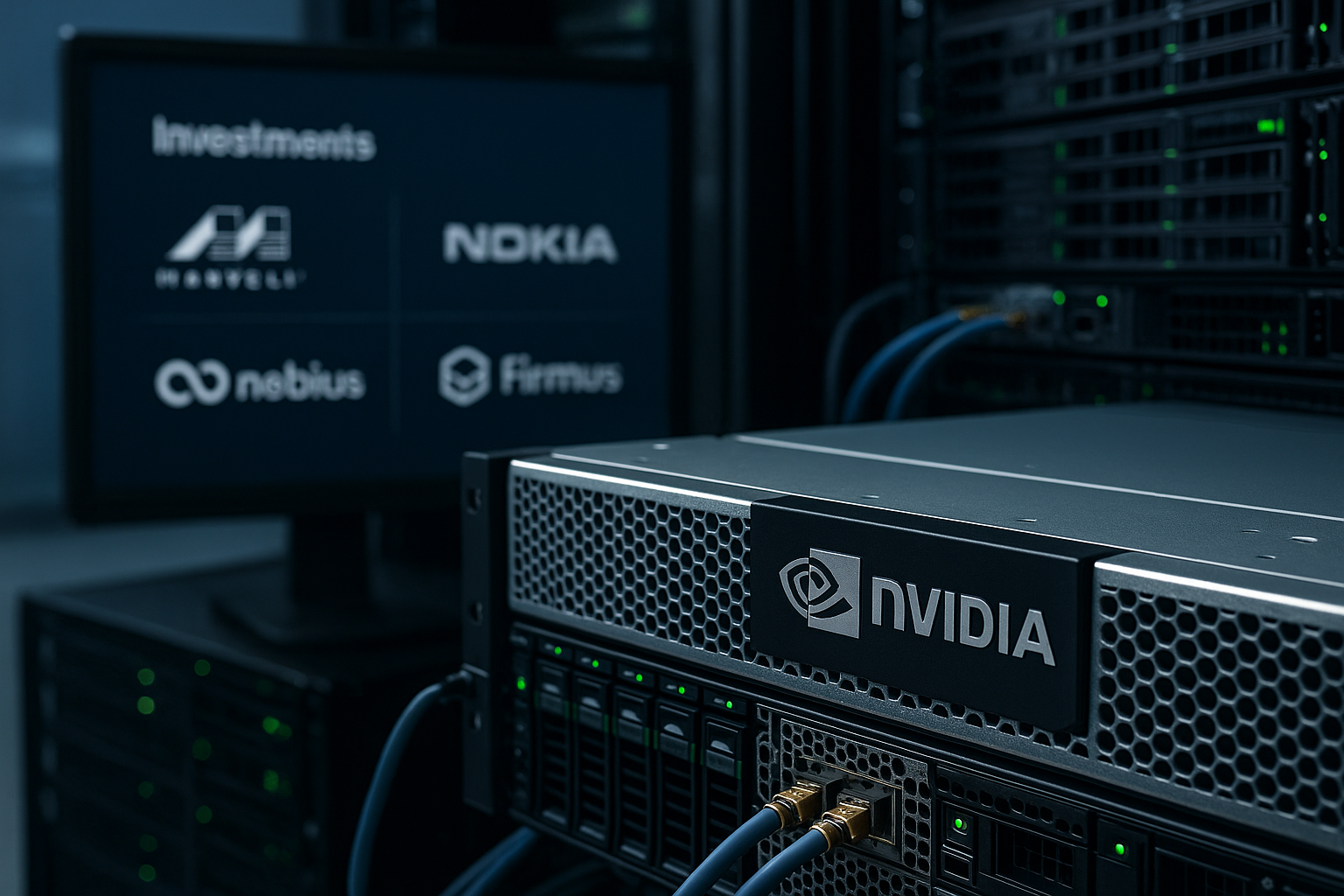
The clearest numbers in the briefing are large. Market reports say Nvidia committed $2 billion to Marvell Technology, $2 billion to Nebius, and $1 billion to Nokia. Barchart also reported a $10.4 million investment in an AI biotech company, while the Australian Financial Review said Firmus was nearing a $6.9 billion valuation in a new Nvidia-backed capital raise. The source set does not provide full deal terms, ownership stakes, or board rights in any of the cases.
The money is spreading across the stack
Marvell is the cleanest example of how Nvidia’s capital can travel beyond its own chip business. Investor’s Business Daily reported that Marvell stock rose after Nvidia announced a $2 billion investment and a strategic partnership focused on AI data center infrastructure, and Markets Insider reported a similar jump tied to the same deal. That matters because Marvell sits in the plumbing around AI systems, not in the role Nvidia occupies as a GPU supplier. Investor's Business Daily and Markets Insider both tied the move to the announcement.
Nokia points to another layer of the buildout. Artvoice reported that Nokia stock was up 140 percent in 2026 and linked the gain to demand for optical networking gear used in AI data centers, along with Nvidia’s reported $1 billion investment. That is a different part of the system than semiconductors, but it is no less relevant to how much AI compute can be deployed and connected. Artvoice tied the move to networking demand.
Nebius shows the cloud side of the same strategy. Benzinga reported that Nebius stock jumped after a $27 billion Meta deal and a $2 billion Nvidia investment, and said the company posted 841 percent AI cloud revenue growth in record first-quarter 2026 results. The source set does not separate how much of the share move came from Nvidia’s backing versus the Meta contract and operating results, but the market reaction was clearly tied to both. Benzinga reported the revenue figure and the stock move.
Market reaction is part of the message
These deals have not moved in silence. Marvell shares rose after the Nvidia announcement, Nebius hit new highs after its Meta contract and Nvidia support, and Nokia’s stock rise was strong enough to draw a separate article focused on the move. That matters for investors because Nvidia is not only placing bets. It is also sending a signal to the market about which suppliers and operators sit near the center of AI spending.
Finbold’s report on Nvidia’s own share price points to the same market logic from the other direction. The outlet said $1,000 invested at the start of 2026 would have grown as NVDA reached new all-time highs, though that report did not tie the return to Nvidia’s outside investments. The company’s stock momentum and its capital activity are being discussed in the same breath, which helps explain why these investment headlines land so hard with traders. Finbold
Capital may matter as much as chips
The chip launch still matters. Nvidia’s products remain the engine of its business, and none of the reporting in this source set says otherwise. But the investment activity suggests a second source of power: access. By placing capital with suppliers, network vendors, cloud operators, and smaller AI companies, Nvidia can help shape who gets funded, who gets capacity, and which companies sit closer to the center of the buildout.
That is a different kind of control than a product launch delivers. A chip release can win headlines for a day or a week. Capital deployment can affect who gets to buy equipment, expand networks, and lock in customers. The source set does not provide Nvidia’s own explanation for the strategy, so the rationale has to be read from the deals themselves.
Firmus points to the private-market side of that approach. The Australian Financial Review reported that the company was approaching a $6.9 billion valuation in a fresh Nvidia-backed capital raise and said it could be the company’s last round as a private business. That kind of transaction is not about a single product cycle. It is about financing the next phase of buildout before a company reaches the public market. Australian Financial Review
The broader signal for strategists and investors
For technology strategists, the reported pattern points to Nvidia acting as an ecosystem financier rather than a vendor with a narrow product message. For investors, it raises a different question: whether the companies closest to Nvidia’s capital will benefit from more durable demand than peers that only sell into the same market from a distance.
The briefing does not answer every question. It does not say whether the investments came with governance rights, supply contracts, or preferred access to future capacity. It does not explain how Nvidia picks targets, or how often it makes these investments. It also does not say whether the stock gains in Marvell, Nebius, Nokia, or Firmus came mainly from Nvidia’s backing or from each company’s own operating progress.
What the source set does show is a company pushing its influence well beyond product announcements. The next phase of AI buildout may depend as much on who Nvidia funds as on what Nvidia ships next.